

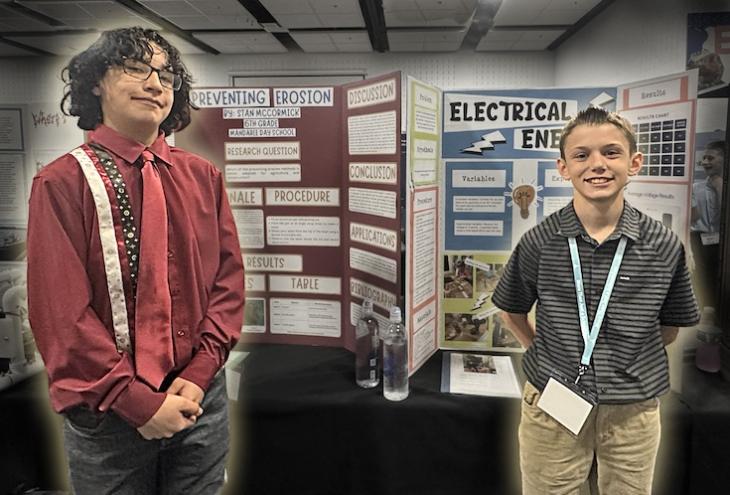
For some students, the science fair has become a tradition to look forward to each year. For others, it’s a frightening new challenge. Whatever your experience level may be, participating in a science fair provides much more than competition. The experience offers an opportunity that could influence your academic path or even your career. While only a handful of students walk away with an official award, most leave with the lasting prize of a new mentor, peer network, or professional aspiration. Entering a science fair doesn’t have to be complicated. The path to a meaningful entry begins with focus and determination.
Do your homework
First, be sure you know the rules of your science fair and all the entry deadlines. Then register on time. Next, focus on a question that’s meaningful to you. Whether you’re a K–12 student or enrolled in higher education, the best results come from pursuing an experiment that’s truly of interest to you. Your project may involve a single field such as biology, physics, or chemistry, or it could cover a range of disciplines. Don’t get bogged down with the science factor. For example, if you’re a football fanatic and you’re curious about the best angle to kick the ball for optimal distance and “hang time,” you could tackle that question for your entry. The application of some scientific principles could help you come up with an answer — and become an interesting science fair project. Once you have a question, it’s time to construct your hypothesis. It could be “kicking the ball at X additional degrees for every Y yards from the goal line will increase your chance of the ball meeting the inside corner of the goalpost by Z percent.”
Conduct your experiment — test that hypothesis thoroughly
Before you do anything, be sure you’re keeping notes every step of the way. Your experiment log is your official record of your project. Here's what it should include:
- Your hypothesis and the key variables at play. You should also make a few notes that explain your thought process leading up to the hypothesis, and why it matters to you.
- Your step-by-step experimental procedure. Think of it as a list of instructions that someone else could duplicate without any questions.
- A record of repeating the experiment, and each set of results. It’s critical that you conduct your experiment at least three times. In order to draw credible conclusions, you should verify that your results are reliable and not some kind of fluke.
Draw your conclusions and create a presentation
In addition to meeting the deadlines, there are other rules to keep in mind. Different science fairs have different formats, so you’ll want your presentation to comply with all the guidelines from the start. If you happen to miss a registration deadline, take note and keep an eye out for information about next year’s event. The fair’s format will help you determine the best way to communicate these points:
- Your question, hypothesis, and why it matters
- The steps in your experiment and the results each time it was replicated
- Your conclusion based on your analysis of the results
- Questions and considerations for future research
Be ready for questions
In addition to looking at posters and watching demonstrations, judges will ask questions about your topic, process, and results. This is a significant part of the science fair process because it offers a learning opportunity for everyone involved. In fact, it can lead to important conversations beyond the science fair. These are some typical questions:
- How did you come up with this idea?
- Did you encounter challenges as you conducted your experiment, and what did you do to address any issues that arose?
- Did you record any results that you didn’t expect?
- What would you do differently the next time?
- Why do you think your findings matter?
Have fun
Make the most of your project by paying attention to the things that you enjoy about the topic and the experiment. The experience could give you new insights and confidence as you pursue your STEM ambitions, education, and career.
 AISES FACES
The AISES team is made up of passionate people striving to provide Turtle Island with Indigenous STEM knowledge, resources, programming, and events. Every individual contributes their skills and expertise to support the advancement of Indigenous students and professionals in STEM studies and careers. Meet one valuable team player who is focused on supporting student members, like you.
Chloe Roughface-Smith, NAISEF Director, PK–12 Program Officer
How does your role impact AISES student members?
I work primarily on the National American Indian Science and Engineering Fair (NAISEF) as the fair director. With the help of the PK-12 team, I plan, organize, promote, and direct NAISEF during the science fair season. When I am not working solely on NAISEF, I am helping with other grants and programs our PK–12 team offers. My job impacts student members because I am working directly with students and educators to provide resources, education, and materials to increase interest in STEM careers and pathways.
How can science fairs help students at various levels?
Most people identify the biggest advantage of participating in science fairs as award money and scholarship opportunities, but there is so much more! Participants get to meet other Indigenous students from across the United States, which results in lifelong friendships and memories while also interacting with judges and STEM professionals who can become mentors or influencers on future paths. Personal attributes and skills that can be discovered or sharpened by participating in science fairs include critical thinking and problem-solving, research skills, creativity and innovation, and communication and presentation. Students can also walk away with a great sense of accomplishment and perseverance as well as increased confidence.
What is NAISEF? How does it differ from other science fairs?
NAISEF provides a hybrid (virtual and in-person) science fair that gives Indigenous students in grades five–12 an opportunity to showcase their interests and expertise in science and engineering. The goal of NAISEF is to reduce barriers that may hinder a student's ability to participate in science fairs while celebrating our young Indigenous scientists.
What are your top three tips for students who are preparing for science fairs?
- YOU are the expert on your research topic. Be confident and excited about what you are presenting.
- The more detailed your science project can be, the more your project will stand out. Try solving a local or centralized problem that you or your community are personally experiencing. This allows you to apply critical thinking skills while also identifying a unique issue that will make judges remember you.
- It is okay to fail. Failure allows you to define your project and find solutions. Your "mistakes" help tell your story and can prove how monumental your findings are.