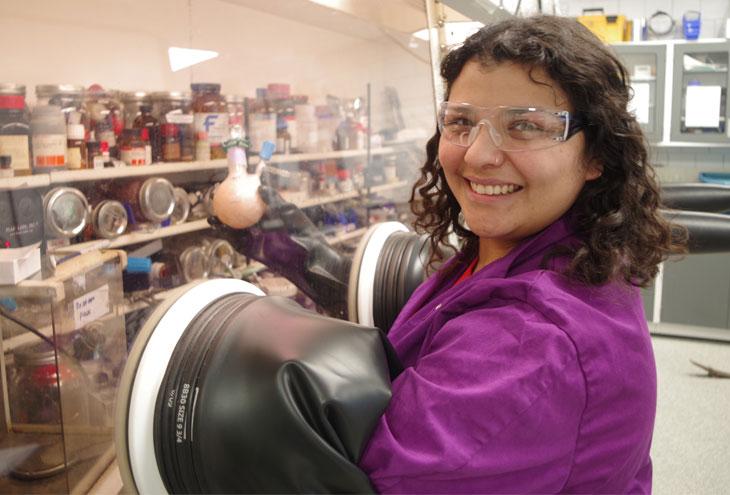
My research focus is molecule-based magnetic materials — we make different molecules that demonstrate “magnetic memory.” If we alter the temperature, pressure, or magnetic field, bonds on the molecular level can break and reform. The science is applicable to technological advancements, such as materials in computer chips.
Growing up in Brantford, Ontario, I knew I am Ojibwe and my mom came from Wiky (Wiikwemkoong Unceded Territory) on Manitoulin Island, but I didn’t really have access to traditional teachings. In high school, I excelled at math and liked science, so I ended up in chemistry in university. I liked that inorganic chemistry has more problem solving, like putting together a puzzle, and I thought the lab work and group dynamic were cool.
Finding the will to stay in the program was hard. As my studies progressed, I started noticing I was the only Indigenous person in every space I went into. I learned about the Indigenous Student Centre on campus, but the thought of going there was daunting because I felt on the outside looking in, like I wasn’t Native enough to go. In my fifth year of undergrad, I finally realized we are all in a similar situation of growing up Indigenous but not really knowing what that meant.
Mental health became a big obstacle impacting my grades in undergrad, and in graduate school I started to realize that I was dealing with intergenerational trauma. Looking into my family’s history with the residential school system fueled me to pivot in my studies to understanding the lack of representation in STEM and promoting Indigenous visibility and voices in STEM. I had the realization that if Canada had its way I wouldn’t exist, so why was I getting out of bed every day to progress Canada’s research? That set me on this path to get more Indigenous people in STEM.
When I got to grad school, I was more desperate to find a sense of community and started to get more involved, learning about my identity and how that fits into all this. I’m currently co-chair of the Indigenous Student Society, and my thesis will be presenting both my chemistry and possible improvements to better support Indigenous students.
Around 2021, the University of Guelph rolled out a commitment to Indigenization. In 2024, beautiful Indigenous artwork was installed in our science complex’s atrium, which was renamed Waasamowin, Anishinaabe for being bathed in light. Representation like this makes Indigenous students feel more seen.
Last year I had the wonderful opportunity to take a field course called Conversations with the Sámi, a cultural exchange that took us to Sweden and Norway. In this course one of my assignments was to compile an annotated bibliography on literature out there that weaves Indigenous knowledge into teaching the sciences. I was inspired by Dr. Michelle Hogue’s work at the University of Lethbridge using the medicine wheel to teach scientific inquiry, and I’ve seen papers using Indigenous languages to teach the periodic table. I read a paper that considers ways to teach about the elements through dance, artwork, or ceremony.
I never considered myself artistic until I started learning about my culture, making dreamcatchers and doing beadwork. I also created created cover art for the ACS publications Inorganic Chemistry and Analytical Chemistry that has been well accepted, and that’s something I’m very proud of. In my Inorganic Chemistry cover art, I use the dreamcatcher to tell my story of belonging — all the things I was grappling with were caught within the web, waiting to be released in the light. Those feelings are not as heavy anymore because I’ve gotten more involved with my Indigenous community.
This year I made my own fancy shawl regalia and danced at my powwow for the first time. To finally claim it as something that is mine was one of the best things that’s happened to me. And I attended my first AISES National Conference. To see this huge room full of Native people at the closing banquet and ending with a powwow was the most incredible experience.
My dream job is to work for a scientific organization and build bridges with Indigenous communities to foster trust and create opportunities. I would tell aspiring STEM students to lean into their culture and identity. Being Indigenous in STEM is not a disadvantage but a strength. Community, culture, and academic success can thrive together.