
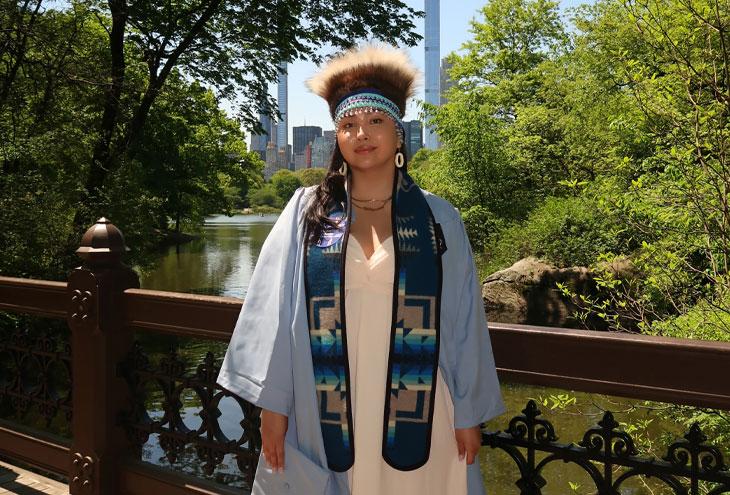
From the time I was a young girl, I’ve wanted to help my people, the Yup’ik. Our remote Native village, Kongiganak, is in Southwest Alaska just a few miles from the Bering Sea. Living near the Kuskokwim River, which empties into the sea at the Yukon-Kuskokwim Delta, I saw that engineering solutions can play a critical role in preserving our lands, our homes, and our way of life.
Those early experiences influenced me to pursue civil engineering and applied science in water resources, with concentrations in Earth and environmental engineering and anthropology. I’ve been an AISES member since my undergraduate days at Columbia University and attribute much of my success to the organization as well as to the Alaska Native Science and Engineering Program. Both provide networking opportunities and the chance to make lasting friendships.
My great-grandfather predicted climate change in the 1960s with the rising waters near our coastal village. He helped people drag their homes, which are built on movable foundations, to higher ground. Just this past October Typhoon Halong had a significant impact. The record flooding devastated my relatives’ area. Numerous houses floated off their foundations and several people went missing. Flooding often impacts our lives, yet we were unjustly forced by the government to live in these areas amid a harsh environment. Although the current administration declared the area a natural disaster and released funds to rebuild, it isn’t enough for a full recovery.
I’m thankful for my culture and where I grew up, and I want to continue my great-grandfather’s legacy of finding creative solutions to environmental challenges. In my village and other Indigenous communities such as my dad’s, who is Samoan, there is a lack of infrastructure for clean running water, even after many generations in these areas. We are climate refugees — but we are smart and ambitious, and we will come up with solutions.
Professionally I’m currently a design engineer working out of the New York office of Sherwood Design Engineers. I am part of a wonderful team offering sustainable solutions for ecosystem services, stormwater management, flood risk reduction, climate resilience, urban green space, and landscape master planning. I also serve as youth climate advisor to United Nations Secretary-General António Guterres — I’m one of the first Inuk to be appointed to this role.
As North America regional facilitator with the Youth Climate Justice Fund, I focus on strengthening youth inclusion in climate decision-making and supporting coordination across Alaskan and Alaska Native youth and organizations. I stepped into this role because young people — particularly Indigenous youth — are too often excluded from climate spaces, despite being on the frontlines of climate impacts.
Separately, in my work as a climate advisor, I advance the policy reclamation rights of Indigenous people to ensure these rights are upheld by the federal government. This work centers Indigenous sovereignty and accountability within climate governance, translating community priorities into actionable policy pathways.
We can help global leaders ensure Indigenous peoples have a voice for resolving climate change and that our rights are protected. It’s time that new buildings and infrastructure are co-designed with Indigenous communities in mind. Taking an active role in helping Indigenous and underserved communities gives me a great deal of satisfaction. Ultimately, I’d love to start my own engineering firm so I can design infrastructure for Indigenous people throughout the world.
Another passion of mine is lilnativegirlinSTEM, a community for and by Indigenous women, girls, and femmes in STEM that I founded in 2022. The scarcity of women — especially Indigenous women — working and studying in the STEM fields is alarming. LilnativegirlinSTEM provides a framework directing our students to leadership roles and fostering systemic changes in education for Indigenous women and girls in science, engineering, and conservation. Our goal is to provide culturally informed education, to foster possibilities across the Arctic, and to cultivate a community of STEM-educated Indigenous women and girls who can unite in community.