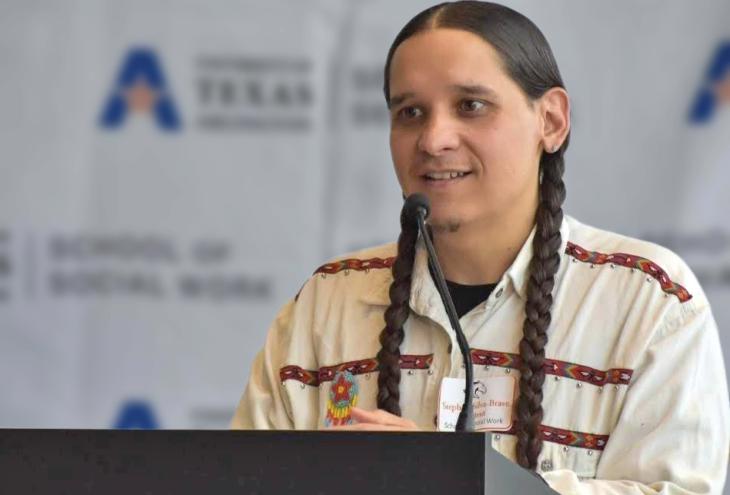
For Stephen Silva-Brave, education is tied to community. A citizen of the Rosebud Sioux Tribe of South Dakota, Silva-Brave credits his current path to his Grandmother Eleanor Brave. She was raised on the Rosebud Indian Reservation but moved to Dallas as a young woman through the BIA Urban Relocation Program. She then split her time between Texas and South Dakota, and her grandson continued this tradition, visiting relatives on the Rosebud Reservation throughout his life.
Silva-Brave pursued his education in Texas but found his purpose through his Native
community. “At first I wasn’t able to succeed at college,” he says. “I started right after high school, but I was a young father of two kids and ended up leaving. I tried to go back but ended up on academic probation and then on suspension. I thought college wasn’t for me.”
Silva-Brave also struggled with addiction and mental health challenges for several years. A turning point came in 2016 when he became a caregiver for his grandmother and received her wise counsel. By 2018, he had achieved sobriety and was determined to return to college. At Dallas College, he earned a certificate and then an associate degree in substance abuse counseling.
As Silva-Brave’s interest in community organizing grew, one of his professors suggested he pursue social work. “They told me there aren’t a lot of men, especially Native men, in the field and that I would be needed there,” Silva-Brave explains. He decided to enroll in the degree program at the University of Texas at Arlington. “In our Native communities there can be a negative view of social workers. But as I learned more in my classes, I realized social work is about advocating for our communities and working to change systems.”
When the campus Native American Student Association reached out for help with their powwow, Silva-Brave got involved, and this connection had a profound impact. “I became proud to be a Native student,” he explains. “Building relationships and networking with other members of the Native community was life changing.”
Silva-Brave had long had an interest in supporting the MMIW movement and had become a member of MMIW Texas Rematriate. As part of the organization, he attended an MMIW conference where he heard about the lack of research and advocates in academia. “That was the push,” he says. “I felt my calling in this work.”
He began conducting interviews with leaders of the movement, and the more Silva-Brave listened to their stories and dove deeper into his research, the more he wanted to expand his work. “I don’t have any relatives with a PhD. I didn’t know how to pursue that, but my faculty advisor encouraged me to go for it,” he says. In 2023, Silva-Brave graduated with his BSW and enrolled as the only dual master’s-PhD student in UT Arlington’s program. In 2024, he was named a Native Forward Student of the Year, and in 2025, he earned his LMSW (licensed master of social work) and is currently on track to graduate with his PhD.
His dissertation research is informed by his ongoing work with MMIW Texas Rematriate, which focuses on locating missing Indigenous people, raising awareness, and obtaining justice for victims and families. One of Silva-Brave’s proudest efforts with the group is organizing Kinship Gatherings, made up of a women’s, men’s, and Indigiqueer group where Native community members can have conversations they may not be able to have elsewhere. “Creating safe spaces is one part of addressing this crisis,” Silva-Brave explains. “We need to build relationships first,” he says. “That is how we decolonize research and social work.”
Looking to his future, Silva-Brave envisions one day teaching, possibly at a tribal college, and implementing his dream of decolonized social work in tribal communities. “’Repowering’ is an Indigenous take on ‘empowering,’” Silva-Brave explains. “Instead of focusing on becoming empowered by someone else, with repowering we remind people who they are.” His theory looks to the historical resilience of Indigenous people and works to reclaim that power. “I want to share the stories of repowerment of our people and our communities,” he says.
Silva-Brave has learned the dual importance of pursuing an education and connecting with community. “We need more Native students,” he says. “Having a degree opens doors.” He points out that you don’t have to have it all figured out, and finding the support you need will be worth it. He recommends reaching out to AISES and campus Native student associations and taking advantage of scholarships. “We need our voices heard, and we need to take seats at all kinds of tables, in whatever career we choose,” he says. “As Native students, we often feel that we walk in two worlds — that of our lived experience and that of our education — but bringing both together is when you are most powerful.”