
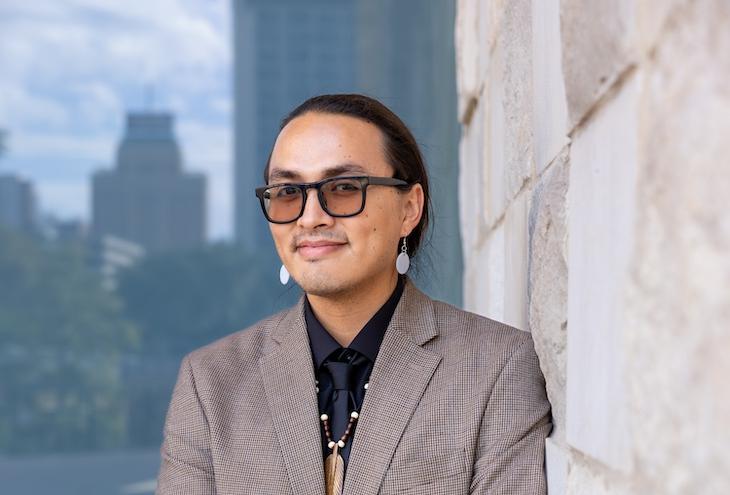
Sometimes what matters isn’t where you go or how you get there, but who’s by your side. For Dr. Alvin D. Harvey, a postdoctoral fellow at MIT’s Space Enabled Research Group, that journey has taken him from a rural childhood to the forefront of Indigenous-led space research.
Dr. Harvey, Diné, grew up on his ancestral homelands, the Navajo Nation. “We are a nation of people as diverse as the sage and stones of Diné Bikéyah, forever seeking the direction of the ancestral stars,” he says. His childhood was split between the communities of Thoreau, Fort Defiance, and most importantly, Aztec, where he stayed with his grandparents on a small farm along the Animas River, helping grow crops and raise cows. “The desert, stones, junipers, and sagebrush touched right up to the edge of the farm before it turned into the green fields and cottonwoods along the river,” Dr. Harvey recalls. Those early years, surrounded by the land and the teachings of his grandparents, instilled a deep sense of service and a desire to heal and protect the Earth.
His grandparents’ role was crucial in shaping his path. “They gave me the gift of service and kindness,” he says. “Service to my community, especially my elders, and kindness as a practice of generosity and patience.” Those values eventually led him to engineering, where he saw an opportunity to create tools and systems that would help his community. Besides family, Dr. Harvey was particularly inspired by Dr. Juan-Carlos Chavez, a Sonoran Yaqui scientist who demonstrated how to navigate scientific and academic institutions without leaving Indigenous identity at the door. “After seeing him be Indigenous without any shame or doubt, I thought to myself, ‘You can do that?’” says Dr. Harvey.
His high school lacked STEM-related clubs and projects, so Dr. Harvey’s interest in engineering was shaped by experiences working on the family farm — maintaining aging equipment and finding ways to make the work easier. “I got a great deal of experience working through the engineering design process at a young age,” he says. “My grandfather and I made a great team.”
Dr. Harvey earned a BS in mechanical engineering from New Mexico State University, where a summer internship provided a foot in the door that eventually led to an MS and PhD at MIT. “What helped me get that MIT experience coming from a smaller state school was my undergraduate research. My freshman year I was so fortunate to be given the opportunity to join a NASA-funded research project, which was a lot of work but incredibly beneficial to my understanding of what research even is,” he explains. To expand his understanding of engineering, he earned a private pilot’s license.
Despite his real-world experiences and family support, Dr. Harvey encountered challenges in academia. He missed home — and the stars. Adapting to urban MIT took time, and he often felt behind compared to his peers. To help alleviate these challenges for himself and others, Dr. Harvey founded and served as co-president of the MIT Native American and Indigenous Association (NAIA) to create a space for Indigenous students to find community. Originally a group of five students, NAIA is now an active community that connects the school’s entire Indigenous population. He also served as the graduate representative for the MIT chapter of AISES. “It’s about making a place for ourselves in an institution where we are few in number,” he says.
Now a Fellow of the MIT School of Engineering Postdoctoral Fellowship Program for Engineering Excellence residing in the Space Enabled Research Group at the MIT Media Lab, Dr. Harvey is studying Indigenous research methodologies and methods in aeronautics and astronautics, furthering his ultimate goal of creating an Indigenous space agency. “Our people have always had a shared and strong connection to the stars. It will endure beyond any of my individual efforts,” he says. “But my dream is that our collective effort to unite in the protection of all ecologies, from Earth to space, will allow us to not just endure but to grow and heal that connection.”
With his work at MIT and his dedication to community service, Dr. Harvey is paving the way for future generations. “My proudest accomplishments, which have helped me develop both professionally and personally, revolve around the service opportunities I have had with Indigenous youth,” he says. “Indigenous people are a service-oriented people at heart.”