
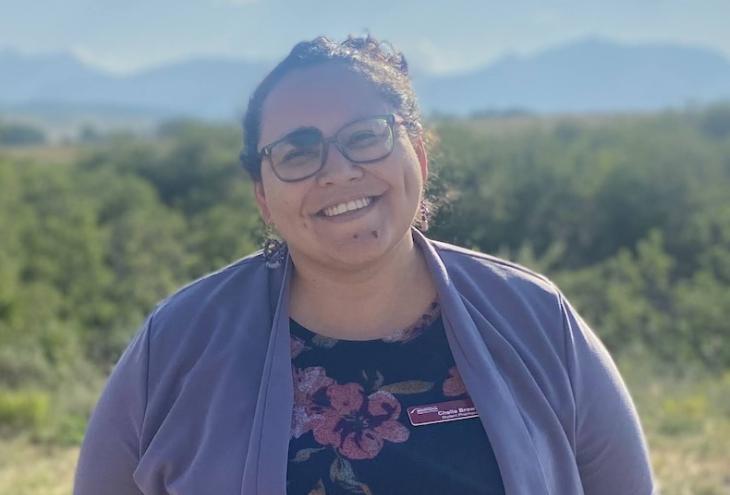
Growing up in a multi-generational household on the Blackfeet Reservation in Browning, Mont., Ispitaki Chelle Brown set her heart on a career in health care. She was inspired by her great-grandmother, who was a nurse, and her great-grandfather, who passed along her legacy. “I was born to serve my people,” Brown says. “Serving others in my community keeps me tied to my culture.”
During her senior year of high school, this call to service led Brown to a training program in pharmacy with the Indian Health Service at Blackfeet Community Hospital. As her interest in a pharmaceutical career grew, Brown enrolled at Salish Kootenai College (SKC). But after becoming a single mother during her first year, she left school and became a pharmacy clerk at CSKT Tribal Health Pharmacy, where she got on-the-job training. She now is a pharmacist intern at that same pharmacy.
Over the next four years, she met her husband, had her second child, and earned promotions. “Despite all the people encouraging me to go back to school, I didn’t feel ready,” Brown recalls. “Then I had a patient from my community who needed help — but I could only help up to a certain point. That moment pushed me to go back to school to become a pharmacist.”
Brown returned to SKC and continued to work at the pharmacy. Even through the pandemic, she persevered. “There were times when all four of us — my husband, who had also gone back to school, and both kids and I — were all in online classes at the same time. We weren’t going to let COVID stand in our way.”
In 2021, Brown completed her coursework at SKC and enrolled in the Skaggs School of Pharmacy at the University of Montana. The daily 124-mile commute was only one of the challenges that awaited Brown. “Being in a professional program at a university is such a leap from the tribal college experience,” she explains. “Figuring out how to pay for gas, study for all the exams, manage my time, and deal with imposter syndrome were all issues. I would think ‘I’m just a little rez girl from Browning — do I really belong here?’”
Brown’s anxiety spiked when she failed her first exam. “I was so scared they were going to kick me out,” she recalls. Her sister’s friend encouraged her to reach out to the university’s Native American Center of Excellence, but Brown was hesitant. “I wanted to do it all myself,” she explains. “But I failed two classes and was on academic probation. As Natives, I think sometimes we are nervous to ask for help. It took a lot of courage to ask, but I reminded myself that they wanted to see me succeed.”
She was right. The center supported Brown, finding a tutor and helping her reorganize her schedule with fewer classes. As she began visiting the center regularly, Brown gradually felt more grounded and confident. “They make space for me and remind me to make space for myself,” she says. “Whether I forget a pencil or need a braid of sweetgrass to put in my pocket before an exam, I am so thankful for that cultural connection.”
Brown has excelled in her studies and is now in her third year of the pharmacy program, with clinical rotations this spring. As she sets her sights on graduation, she credits her community and her culture. “I feel this journey has happened because of the support of my family and my community that I have served for the past 13 years. I have such a big fan base on the Blackfeet reservation also,” she says. “To help cover my tuition my husband sold fire wood and I made ribbon skirts and both of our children helped us. We all had made little sacrifices to help me get here.” Through it all, Brown remembers who she is as Blackfeet. “Sometimes I sing our ‘try hard’ song from my grandparents’ ceremonies to get me through,” she says.
Ultimately, Brown says that she comes back to the memory of the patient who set her on this path. “I want to pave the way for more Natives in health care because our patients need us to advocate for them. A mentor once told me that as Natives, we are the first medicine makers and the first healers, so whenever you feel like you don’t belong, remember we have been doing this for centuries. You do belong.”