
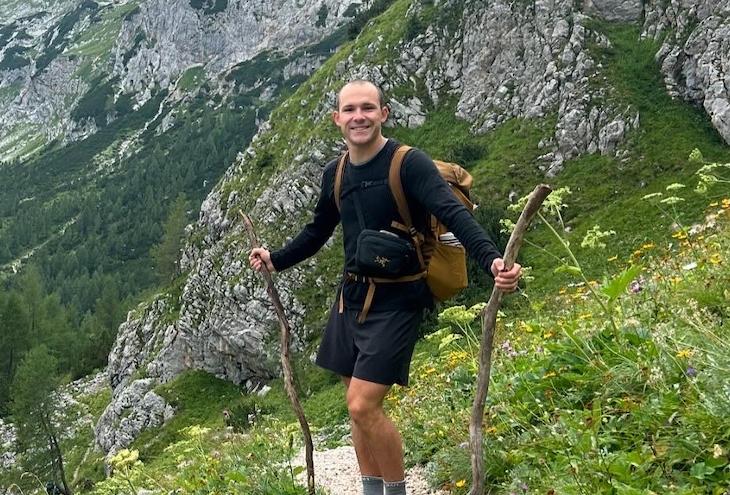
Tackling a double major in computer science and mathematics didn’t faze Fraser McLeod. On the contrary, he graduated from the University of Saskatchewan (USASK) last year with a double honors degree and was recognized as the most distinguished computer science graduate. In his first year at USASK, McLeod was set on a business concentration until he took an introductory computer science course. “It spurred me to completely change my degree,” he says. “Eventually, I was enjoying my math classes so much that I decided to double-major.”
That willingness to adapt and change course, says McLeod, accounts for much of his success at school and beyond. “I’ve always been honest with myself when things aren’t going well and adjusted,” he says. “I’m mindful of where I am now and how that aligns with my long-term goals.”
At USASK McLeod maintained a busy academic schedule, but he balanced his life by making time for activities that were important to him. “I played USport (the highest level of university athletics in Canada) soccer for three seasons,” he says. “I also enjoyed teaching other students and conducted research in quantum computing.”
AISES became another important extracurricular for McLeod. “I was one of the executives who organized and planned the AISES Regional Conference in Saskatoon. I am incredibly proud of our chapter for the successful event we created,” he says. With support from the university, the USASK Chapter of AISES hosted 100 attendees, including professionals, college students, and some 50 high school students, throughout the conference and had 15 presenters from diverse disciplines. “I hope to continue attending AISES events as a professional in the future!” he adds.
McLeod was able to build his success at university on a strong foundation. “I had a great high school experience and was fortunate to be exposed to a wide range of opportunities,” he explains. “I played sports, participated in a specialized outdoor school for a semester, took advanced placement courses, and went on a history studies tour in Europe.”
Another enriching foundational experience for McLeod was learning what it takes to hold down a job. “Outside school I had multiple jobs, working almost every weekend,” he recalls. “Work helped me develop professional skills and learn the value of money. These experiences gave me a solid foundation, helping me discover what I enjoy as well as what I do not enjoy.”
McLeod says that figuring out what you don’t enjoy is important. “Sometimes knowing what you don’t want to do is just as valuable as knowing what you do want to do. The best way to find out is by getting out there and trying,” he advises.
Knowing yourself and learning from a variety of experiences can be a good guide no matter where you are on your path. For McLeod, his path has taken him to Siemens EDA in Saskatoon and a position as a software developer. “Starting a full-time position is a big transition from being a full-time student,” he says, noting that at this point he is focusing on the present: “At the moment it is difficult for me to set career goals long into the future. My current goal is to continue learning: to grow my domain expertise and technical skills.”
He knows from experience what he enjoys and is confident those inclinations will guide his career. “These tenets — learning, challenge, impact, and teaching — are central to what I want my career to be about,” he says. “Over the long term, I hope to find myself in a leadership position where I can share my knowledge and help lead my team to make an impact. Moreover, I hope that I am challenged every day and get the opportunity to always be learning.”