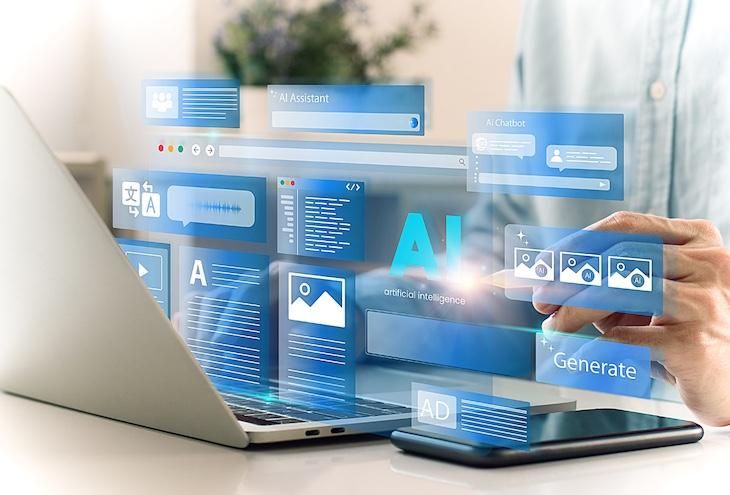
Artificial intelligence (AI) is becoming more mainstream every day. From customer service bots to writing aids, the average consumer is able to access and utilize a wide variety of applications. The power of AI is also impacting today’s workplace. The technology is expected to increase efficiency, reduce costs, limit human error, and help with decision-making. Currently, AI on the job is primarily used to help with automation, data collection, and improving the employee experience.
Automation
AI is helping to streamline many administrative tasks. For example, it can be used to automate scheduling, compare calendars for optimal meeting times, and reserve resources like conference rooms or special equipment. It’s also helpful with data entry, invoice processing, and requisite paperwork for new employees. One of greatest areas of efficiency can be found in AI-powered email filtering and intelligent routing systems. They automatically sort and prioritize messages, as well as identify and draft responses to routine questions. AI-powered email significantly frees up your time and reduces the number of important but tedious administrative tasks.
Data Collection
Raw data drives most management decisions. To that end, AI is a valuable tool for gathering data about the workplace. Sensors that detect when people are physically in an office can help reduce wasted energy and better project overhead budgets. AI also can be used to identify digital communication patterns. Although humans are capable of gathering this information, AI gathers and analyzes it at incomparable speeds, while also identifying trends, links, and inconsistencies.
In today’s world of hybrid workplaces, AI is helpful at examining how office space is used — or underutilized — to help create more effective office layouts. Similarly, the technology can identify shifts in employee behavior to better understand their inclination for at-home or in-office work and preferred areas to collaborate with colleagues. Another use is predicting and planning for maintenance before major issues arise. Having clear, detailed information allows management to make smarter decisions that ultimately improve efficiency and long-term plans.
Employee Experience
Increasingly, AI is used to directly improve the employee experience by making the job more customized and efficient, and the environment more supportive. AI powers personalized learning platforms that adapt training content to an employee’s needs and preferred learning style, which encourages ongoing skill development. AI-powered chatbots are available to provide instant support and answer common HR, IT, and other questions at any time. Getting a quick, on-demand answer lessens wait times and frustration, and increases productivity. Many employees find AI most helpful when it comes to managing their workload. Whether it’s designing customized workflows, suggesting resources, prioritizing projects, or filtering information, the result is a more constructive workday.
AI is enhancing today’s workplace efficiency by automating a variety of recurring, monotonous tasks that historically were handled manually. And AI is helping leadership teams make informed decisions by providing clear data. Employees also benefit from AI-powered learning tools, productivity features, and support systems. Bottom line: Don’t fear AI as it cannot replace the unique skills humans bring to the table. Instead, embrace the efficiencies it offers.
ON TOPIC
AI is the way of the future, and it’s important to prepare employees for the inevitable partnership between humans and AI. Professionals in just about every field will need to expand their skillset to succeed in a workplace that utilizes AI. Of course, there will always be a need to draw upon our human connection, including qualities like creativity, empathy, and judgment, but we need to be prepared to use those skills in combination with some fundamental tech knowledge. Moving toward the idea of a human–AI partnership requires a shift in mindset. Those who are successful will embrace lifelong learning, encourage experimentation, and recognize that uniquely human skills are still critical in the world of AI.
Those critical skills for an employee working in an AI-inclusive workplace should include the following:
- Human skills: Critical thinking to interpret AI's findings; creativity to innovate beyond AI's capabilities; empathy for leadership and customer interactions; and ethical decision-making to ensure responsible AI use.
- AI literacy: Understanding AI's capabilities, limitations, data processing, and potential biases to leverage tools smartly.
- Clear prompts: The ability to give clear and concise requests to get the best results from generative AI.
- Collaboration: Encouraging teams that include both human and AI input — with individuals recognizing AI as a partner to improve their performance.