
Keeya Wiki’s first name — a Yurok word tied to rising — serves as both a vision for her future and a reflection of her path. A senior at Ashland High School in Oregon, Wiki already navigates the world of international diplomacy with the poise of a seasoned advocate. Beyond just maintaining an inherited connection to the lands and waters of her Yurok and Māori ancestors, she embodies that connection as a foundational responsibility — the grounding factor of her identity.
While many ecologists begin their deep study in a university lecture hall, Keeya’s education began with the conversations around her. “I grew up attending a lot of community events and tribal council meetings with my family, and those moments definitely shaped me into the person I am today,” she explains, pointing out that she was raised by her entire family on both sides. “My mother, Geneva Wiki, and father, Reweti Wiki, are my biggest influences,” she says. Keeya also has two sisters, Te Maia (20) and Ani (11). She says that other important people in her life are her great-grandmother Lavina Bowers, her grandparents, and all her aunties and uncles.
On the reservation, her grounding in traditional ecological knowledge was articulated through her community’s foundational truth: when the river is sick, the people are sick. While this may seem like a logical ecological concept to an outsider, Wiki embraces it through an ancestral and spiritual lens. It is a connection to place that recognizes an extensive timeline — one that stretches far back and far forward into the lives of those not yet born.
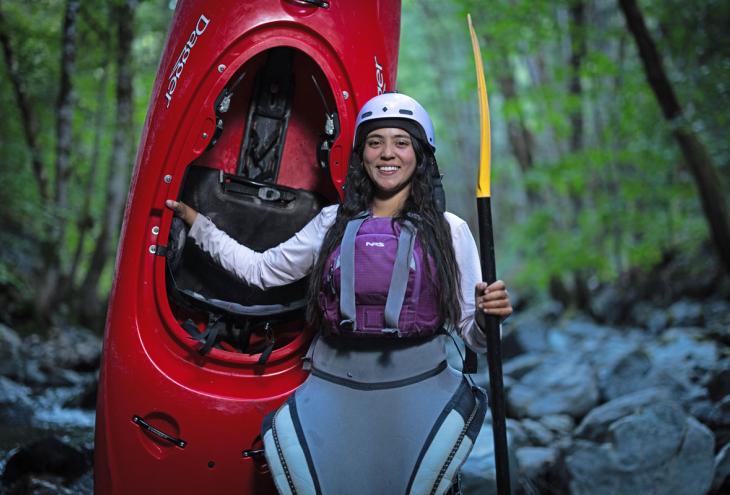
Two years of preparation through the Paddle Tribal Waters program led Wiki to a truly once in a lifetime opportunity — the first descent of the Klamath River, which after 100 years of concrete barriers was largely undammed in 2025 (two dams remain). Wiki met the celebration of dam removal on the Klamath partly with a sense of sorrow for a river imprisoned for so long, along with gratitude for the healing of a place revered for thousands of years. Wiki and the young people alongside her see themselves as a generation raised up by fighters for the water and the land, and they welcome the opportunity to reconnect to a place they all come from — the Klamath River Basin.
The historic experience of making the first descent on the newly freed river resulted in an invitation for Wiki to COP30 — the United Nations Climate Change Conference of the Parties 30th session held in Belém, Brazil. At just 17, she had a clear message: hydropower is a false climate solution, and Indigenous voices will not be silenced. River advocacy was part of her upbringing, part of her formal training with Paddle Tribal Waters, and at COP30 she was able to share facts on a global stage about hydroelectric methane emissions and the narrow circumstances that could frame hydropower as a climate solution.
But the most challenging aspect of her COP30 experience was not public speaking. “It was being so grounded and so connected to a river, and then coming to a place where it felt like no one was grounded and no one had a connection to the land or water,” she says. Wiki realized that many of the lobbyists there “fighting for land and water resources” were disconnected from the land and water as living entities. Globally representing the sacred relationship to place shared by Indigenous people is a tall order for anyone, yet Keeya navigated the experience as an anomaly at COP30, disrupting the space wearing ribbon skirts and traditional Yurok basket cap.
Reflecting on the first descent of the Klamath, Wiki noted that future generations will never know the river she knew growing up — impeded by dams. While this brings her comfort, it is not enough. Future generations will have uphill battles, but she hopes not as steep. Wiki encourages young people to find others who share a passion to protect their homelands. While she is looking forward to enjoying the last months of her senior year, she is considering her future, possibly in climate, education policy, or natural resources, with a primary goal of serving her community and homelands.