
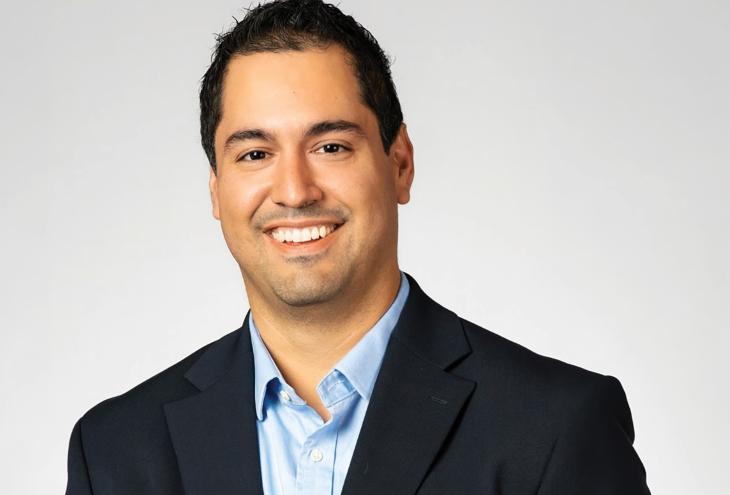
Dr. Thomas Reed has approached his education, career, and commitment to the Indigenous STEM community with enthusiasm and dedication. Dr. Reed, Hopi, has firsthand familiarity with the financial challenges many Indigenous families face in both reservation and urban settings. “After all the needs were met, we didn’t have much left growing up,” he recalls. “I saw family members and friends who were engineers working for decades at Boeing, near where I grew up in Seattle. I was looking for that same stability, so I decided to pursue nanotechnology because I heard so many people talking about it.” With three electrical engineering degrees, several published technical papers, and three patents, he apparently made the right career choice.
Dr. Reed earned a BS in electrical engineering, with a minor in mathematics, from Brigham Young University, and obtained his MS and PhD in electrical engineering from the University of California at Santa Barbara, where he co-founded the AISES College Chapter. “I applied for a variety of scholarships, many through AISES, so when I graduated, I had zero student debt,” he says.
Today Dr. Reed is a principal electrical engineer in microelectronics product development at aerospace company RTX Corporation. More specifically, he is a gallium nitride/gallium arsenide radiofrequency/microwave monolithic microwave integrated circuit designer for his company, work he finds challenging and stimulating. “After designing a chip, I shepherd it through the process to ensure it will meet the expectations of its application for a defense, aerospace, or other high-tech system,” he says.
That process includes numerous design reviews and batteries of tests, and it can take several months before a chip is ready for production. “I’ll follow my chips’ lifecycle into fabrication, and sometimes when the engineers install the chip into larger assemblies, they will contact me to help resolve issues with integration. It’s very satisfying when I’m learning new things and I’m part of a team,” he adds.
Dr. Reed takes the same approach to supporting the Indigenous STEM community as he does to his job. He played a key role in the corporation’s diversity, equity, and inclusion efforts through the company’s employee resource groups, with a focus on the RTX American Indian Network (RAIN). He served for 11 years in roles including RAIN vice president of global operations and global co-chair, which gave him leadership opportunities on a large scale.
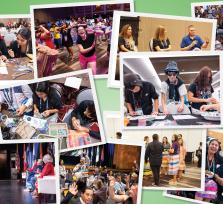
He has attended many AISES National Conferences, often with a contingent of colleagues, to meet with students and discuss career opportunities. He has also presented on several technical topics, sharing his professional experiences and knowledge. “I remember attending my first AISES National Conference in Anaheim, Calif.,” Dr. Reed says. “I drove down in the middle of the night from Santa Barbara to get there. I was very shy back then and really didn’t know anyone, but I attended the sessions. I could tell I did better every year as I kept participating in more conferences and presented papers or submitted posters.” AISES presented Dr. Reed with the Most Promising Engineer Professional Award in 2017. He is also a Sequoyah Fellow, underscoring his lifetime commitment to AISES and its mission.
Dr. Reed’s network quickly expanded through AISES events and led to an internship with Sandia National Laboratories in Albuquerque, N.M. His participation at another AISES conference gave him an opportunity to meet Raytheon representatives, and his participation at another technical conference ultimately led to his current position with the company.
Looking to the future, Dr. Reed plans to pursue either an engineering fellowship or the management track. And helping guide and inspire other Indigenous STEM community members remains a priority. He recently joined an AISES mentorship program to provide support and networking opportunities and is currently founding an AISES Professional Chapter in the Boston area where he now lives with his wife and family. He says he is motived by the challenges resulting from executive orders aimed at dismantling DEI programs. “I’d like to help fill the hole that is there for Indigenous students and professionals who need a supportive community, just like I did.”